History of the Musical Experience
As far as we know, every culture that has ever existed has had music for:
- Self-expression
- Communication
- History/culture
- It's not just about the text; if it were, one would just read it
- Music as a Physical, Psychological, Aesthetic, Cultural Phenomenon--The
notion comes from the American Musicological Association, who define "musicology" as the above
- Physical Aspect of Music
- Music was first taught in the quadrivium of the Middle Age universities
- Described in the context of the "music of the spheres"
- Boethius--pulled together the existing body of knowledge under his own "slant"
- Musica humana--ratios and relationships inside the body
- Musica mundana--ratios and relationships in the universe
- Musica mentalis--music theory (per se)
- Knowing how the music is received
- Psychological--Composer, Performer, Listener
- Composer--"what was he thinking?"
- Music is a form of communication (feeling, fact [history or fiction])
- It is a creative act
- It is an expression of emotion
- Performer
- The same three as for composer
- It is all about interpreting the composition
- Singing is a refined "primal scream"
- Listener
- How is the sound perceived? (Gestalt psychologists dealt with perception) Music happens in
time--it is actuated, then it is gone
- Expectations
- Memory
- Doctrine (theory) of ethos--the effect of music on character or personality
- They thought certain modes had certain effects and had to balance each other (Plato, Aristotle)
- Baroque concept
- Doctrine of affections--had to do with evokingh a mood or response (not particularly specific in music)
- Music Therapy--affecting the mind (physically, emotionally, psychologically)--pertains to what the
listener assigns to the music as much as what is meant by composer or performer to be communicated
- Aesthetics--a sense or contemplation of beauty
- An attempt to find beauty
- What is it about music that makes it great or poor? (specifically, beautiful)
- Cultural
- Music in its cultural context--not just how was music put together and performed, but how was it received?
How was it related to the culture?
- Ethnomusicology--relates to the study of the cultural effects of music (sort of becomes the "catch-all" for
questions no other field of music study tries to answer)
- Who is allowed to produce music?
- Who is allowed to perform it? Where is it performed? Why is it performed?
- The experience of music--is it entertainment?
- Music in culture--attitudes toward music--who does it? Men? Women?
- Music as culture
- Influenced by other aspects of culture
- Influencing other aspects of culture
- Alan Merriam's "Functions of Music" from The Anthropology of Music (see Syllabus, p.4)
- Emotional expression
- Aesthetic enjoyment
- Entertainment--mainly used as such by literate cultures
- Communication
- Symbolic representation--part of communication; semiotics (the science of signs and symbols)--what
does the music mean to me in my personal history?
- Physical response--trancing, other physiological responses meant to be solicited by the music within
the culture
- Enforcing conformity to social norms--nationalism/patriotism (Hitler's use of some musics and
oppression of others)
- Validation of social institutions and religious rituals--reinforcing identification and association
- Contribution to the continuity and stability of culture--describes who we are in a certain culture at a
certain time in history
- Contribution to the integration of society
- Areas of Study within a Music Culture
- Concept--Ideas about music
- Music and the belief system
- Aesthetics of music
- When is music beautiful?
- When is it beautifully sung or played?
- Contexts for music
- History of the community determines tendencies and directions of change
- Behavior--Social organization of Music
- Sound--Repertories of Music
- Style
- Genres--like a category
- Text
- What is this song saying? How is it saying it? What is an appropriate setting for the text?
- Text and music are two different forms of communication
- Composition--can anyone write music, or only specific people?
- Transmission--how is music learned: written down? Word of mouth?
- Movement--what kind of movement accompanies the music?
- Material Culture of Music
- Musical Instruments
- Physical Description
- Performance Techniques
- Musical Function
- Decoration
- Socio-Cultural Considerations
- Preserved Music
- Cultural Music
- The Music of India--there are actually two different groups of Indian music traditions; both share many
of the same elements; both use ragas and talas
- Hindustani--the northern tradition
- Karnataka sangeeta--the southern tradition
- Raga--the "pitch" component of the music
- Somewhat more than a scale; more like a church mode (the music having a kind of contour);
somewhat between a scale and a melody
- Ancient texts define raga as "that which colors the mind"
- Includes the scale and intonations with ornaments
- Learned by listening to it being performed
- Tala--the time cycle (like an isorhythmic motet); a rhythmic pattern
- Also learned by observation or apprenticeship
- Teacher is known as "teacher," not by name
- He comes in, defines the lesson, then leaves
- Tabla (double drums)--plays the tala
- The Music of Japan
- Discovering the Music of Japan--in Bowld Music Library at SWBTS (video)
- Shakuhachi
- A bamboo flute; end-blown, extensive vibrato created by shaking the head
- Music is written in Japanese characters, top to bottom, then right to left
- Koto
- A thirteen-string zither; long and playedon the floor
- Bridges are placed on the fretboard, and strings are bent by pressing the strings down behind
the bridges
- Shamisen
- A banjo-like lute
- Played with a large plectrum
- Probably the most characteristic Japanese instrument
- Gagaku--the traditional court music of Japan
- Konjen--purely instrument
- Bugaku--court music with dance
- Music of the left--came from China; costumes in red
- Music of the right--came from Korea; costumes in green
- Gamelan music of Indonesia
- Gamelan refers to a set of instruments, not a specific one or a type of music; ordered from one
maker, identified by tuning
- Metallophones
- Tuned, knobbed gongs
- Flutes, fiddles, etc.
- Bronze is the preferred mettle for the instruments, but brass or iron may be used (less tunable)
- Tuned to one of two scale systems
- Slendra--a five-note scale
- Pelog--a seven-note scale
- It is believed that working metals into instruments makes the builder susceptible to mystical forces,
so rituals are performed to protect him
- There are no concerts; the music is performed to accompany life, or perhaps dance or theater
(puppet sometimes)
- Layered music, with ostinato patterns and signals from an instrument to change them (very influential
on Debussy with regard to "blurred" tonality)
- Native American Music
- Depending on the culture, there is strong resistance to Christianity as a result of religious oppression
- Vocables--seemingly meaningless words that convey emotion
- Tonally centric (comes back to some kind of basic tonality)
- Yeibachai--done at the night-way ceremony (lasts for 9 nights) to help cure a sick person, or "get
them back in balance"
- Falsetto singing
- Falling lines to a tonal center
- Rattle rather than drum to maintain beat
- Tlingits--Alaskan Indians heavily influenced by Russian immigrants
- Their vocables are intermingled with Russian Orthodox harmonization
- They are a totem culture
- Pow-wow (like "how") is an Algonquin word; gatherings or dance competitions; always begins with a
flag song
- Aboriginal Music of Australia: Didgeridoo--a rhythm wind instrument that functions as a drone
- Has great ceremonial value that gives color to the world
- Women are not allowed to play in public
- The world may go back to black and white
- The women may have miscarriages
- African Music
- Musical events happen in social situations
- Very important in work and play as well as in rituals
- Music is almost always expressed with other media (drama, dance, etc.)
- Stylistic traditions and polyrhythms (layered ostinato patterns)
- Repetition and improvisation
- Participation--the way the music is done invites people to participate; very improvisatory
- The training for the most part is by enculturation
- Their belief about music is that it is not so much an art as a part of life
- The Ewe (eh-weh) people of Ghana perform Agbekor music (translated "the clear life" or "enjoying life")
- Learned by observation and imitation
- Learners practice in solitude for up to a year
- Polyphonic (some) and polyrhythmic (very)
- A bell indicates when to change musical styles while playing
- African-American Music--the music of people relocated against their will
- Offered an opportunity to "code" messages among slaves
- Developed from the hymnody they were hearing, which they inculcated into their native musics
- Slaves had to sing--be happy and entertaining (field "hollers")
- Ragtime
- Blues
- 3 lines, 12 or 16 bars
- One repeated
- New line
- Jazz
- Latin-American Music
- Andean Music (Bolivians, etc.)
- Panpipe music (flutes in pairs, playing in hocket, sounding very related to hocket)
- Before the Latin influence, the music sounded very old-style and pentatonic
- Western Impact on World Music
- Ancient Greece
- Philosophy
- They provided what has become foundational to our system of music theory
- Doctrine of ethos--they believed that music had certain powers
- They did have a notation system, microtones
- Instruments
- Kithara
- A lyre-like instrument
- Associated with Apollo
- Sometimes played alone, sometimes accompanied singing and reading of poetry
- Aulos
- A reed instrument, single or double (we don't know)
- Associated with Dionysus
- Accompanied Greek drama
- Music
- Tended to be monophonic or heterophonic (two or more lines that are sounding the same melody,
but may ornament differently
- The Greeks wrote about music, especially the doctrines
- Lists/descriptions of meterials and methods of compositions
- Proslam benomonos--the lowest sounding note, according to the greater perfect system
- Understood in three genera, or ways of using the tetrachord:
- Diatonic--follows step-wise; E, D#, C, B, etc.
- Chromatic--like diatonic, but missing notes; e.g., E, C, B, etc.
- Enharmonic--for instanct, E down to C, Cb (some kind of microtone), B, etc.
- Early Middle Ages (A.D. 476-1100)
- Philosophy
- The arts were becoming lost; things were in a great state of disrepair
- Not many agricultural tools
- Very violent societies; homicides were up over 100%
- Abduction for ransom was an acceptable method of livelihood
- Death was the prescribed penalty for many offenses
- A new aristocracy began to arise; any leader strong enough to develop a following became a
nobleman
- There was a different sense of ownership and property
- Noblemen had last names, but few others did
- There was not much sense of the passage of time; things followed the church calendar
- The strong, centralized government came along in 789 with Charlemagne; ordered schools to
be opened for clergy and lay children
- After 1000 they began building universities and rediscovering the ideas of the ancient Greeks
- As Rome declined, monks were preserving the music and their ideas
- Constantine converted in 312; soon others were required to become Christians
- A.D. 395--Byzantine split from Rome
- The popes began feeling a need for a set liturgy
- The proper--parts of the mass unique to a certain week or feast day
- The ordinary--the basic, consistent part the mass
- The offices--done at certain hours of the day by monks
- The Monks
- They did much of the preserving of music and history
- They largely excluded themselves from society, but were from all walks of life
- Nuns and Convents--Hildegard von Bingham (1098-1179)
- Renowned in her day as a poet and prophetess
- As tenth of ten children, she became the "tithe" of her family
- She became very powerful in her small circle
- Considered a "mystic"
- Ordo Virutum--a morality play that represented a battle for souls between the
Virtues and the Devil
- Boethius: Scholasticism--the other side from mysticism
- Responsible for translated Greek theory forward
- Took the accumulated Greek knowledge, wrote it down (adding a few things)
- States that "music is number made audible"
- Pythagorus believed that music is beauty in numbers
- Boethius Christianized all this theory
- Wrote De institutione musica--music is too much a part of us to be ignored or
underestimated
- Music was learned by wrote and repetition
- Instruments were being used as Christianity became more legal, but fell into relative disuse
around AD 300 (but this doesn't mean they were never used)
- Chant
- An effort to standardize the liturgy
- Pope Gregory began to have chants and songs collected and categorized
- In the 1880s the Benedictine Monks of Salem began putting down the chants of the church,
including the liber usualis
- Notation systems were developed to teach the priests in the "countryside" away from Rome
how the chant is to be performed
- Neumas--the figures printed above the text to indicate pitches
- Color was used as part of the notation
- Rhythm is determined by the text
- Characteristics
- Narrow range
- Unmetered
- Sung to the rhythm of the text (free-flowing)
- Stepwise motion
- Trope--added text, music, or both inside a chant
- Sequence--a specific trope added to the jubilus of the Alleluia
- Secular Music
- Jongleurs--wandering musicians and entertainers (low class)
- Goliards--People who had trained as clerics but had dissociated from religion; "wine,
women and song;" wandering scholars (high class)
- Carmina burana--texts of the Goliards
- Trouvères (northern France) and Troubadores (southern France)
- Lots of different classes
- Wrote chansons, which were included in chansonnier
- Written in monophonic style
- Wrote love songs, debate songs, etc.
- Used formes fixe--the "fixed forms" of music
- They often had money and got their music bound and gilded
- Polyphony
- Organum
- Voix principalis--the main line
- Voix organalis--the "accompanied" vocal line
- Musica Enchiriadis, Scolica Enchiriadis--documents developed around the 9th century
- Guido d'Arezzo, Microlugus--a "textbook" on organum that sets rules and ways for
things to be done
- Known as a teacher
- Used a hexachordal system
- Provided us with syllables to teach how organum needed to be done
- Ute queant laxis
- Near San Martial the organum became quite florid and used lots of added notes to the organal
voice, or melisma
- Léonin/Perotin--began the Notre Dame style of composition
- Léonin did lots of chants for the proper; wrote the Magnus liber organi
- Perotin--added to Léonin's work
- "Anonymous Four"--worked with Léonin and Perotin, possibly a student, who took
down lots of their notes
- The soloists sang the organum; the choir would come back and sing in unison
- Rhythmic modes--established a pattern by adding notes to a continuous rhythm
- Discant clausula--a section of organum set over the line that contained the chant text
- Developed into the motet (the words added over the discant clausula)
- Both organum and motets often had more than two voices, each having their own texts (the
medieval motets almost always look like this)
- Equivalents replaced the rhythmic modes, but still presented in pneumes merely tied together
- Philippe de Vitry (1291-1361)
- Wrote Ars Nova, a text on the ars nova movement in France
- Isorhythmic motets
- Applies principally to the tenor
- Contained two components: the talea, or rhythm; and color, or pitch
- The numbers of pitches and rhythms may not be the same, so you would repeat usage
of whichever one is shorter
- Guillaume de Machaut (1399-1377)
- Priest who was a composer
- First to write a unified, complete polyphonic ordinary of the Mass (like Messe di Notre Dame)
- His compositions tended to center on D and F
- Consonances were considered only between top and bottom voices; internal voices could
clash and the music could still be considered "consonant"
- Landini cadence
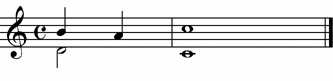
- The Renaissance--c. 1400-1600
- Scholasticism of before is now butting heads with ideas of the Renaissance
- The scholars felt that any knowledge worth knowing has already been written down somewhere
- There was a finite amount of knowledge; they felt it was in fact possible for a person to know everything
- The people of the Middle Ages felt that the world was in zones and that there were places people were and weren't supposed to be
- Renaissance people
- Felt that there was always something to learn
- They were looking for new ways of thinking based on the Ancients, especially the Greeks
- Boethius' theories were rediscovered with the invention of the printing press; his documents (and others) were being translated into the vernacular
- A new world view eventually developed where people were being made aware of the real nature of creation
- Marcillio Faccino
- "Music is important for the spirit as food is for the body"
- He related music to astronomy
- There was a new idea of creation which allowed people to create original works
- People began to trust the ear and emotions to appreciate sounds; this butted heads with the old concept of trusting the mathematic ratios that had heretofore governed composition
- Glorianus' Dodecachordeon added ionian and aeloian (and their plagals) to other the church modes
- Zarlino's 1558 Institutione harmoniche dodecachordeon
- Put the ionian and aeloian in the orders we're familiar
- Tried to explain how to relate emotions and text settings with ratios
- Grouped ratios within 6 scenarios
- Explained that harmonies of 3rds and 5ths were most pleasing to the ear (though they weren't thinking in terms of inversions yet)
- The Renaissance madrigal (16th century) was taken from the new ideas in poetry and literature and was written to reflect this text
- They were through-composed, fairly lofty, and secular
- The idea was to set "emotions," which goes against anything the scholars were saying
- Carlo Gesualdo (c. 1561-1613)
- Used lots of chromaticism
- Fragmented and repeated the text often (madrigals more so than motets)
- Used chords as well as lines
- Lots of chromaticism that sounded like tonality gone wrong
- English music (John Dunstable, John Farmer) was always more "tonal" sounding
- The Renaissance motet--polyphonic setting of a nonliturgical sacrd Latin text (frequently a Biblical text)
- Each phrase of text to different musical idea
- Usually sectional with contrasts in texture
- Imitation is principal compositional device
- Point of imitation--a passage made up of statements of a single subject by each voice in succession
- Overlapping cadence
- Renaissance Composers
- Guillaume Dufay (ca. 1400-1474)--Missa L'homme armé
- Josquin Desprez (ca. 1440-1521)
- Ave Maria, gratia plena
- Missa Pange lingua
- Renaissance Masses and other Catholic Church Music
- Motto Mass--each movement begins with the same melodic motive
- Cantus firmus Mass--all movements based on one pre-existent melody, which could be:
- Secular (more typical in the 15th century)
- "L'homme armé"--a popular tune used by many composers as basis for a Mass)
- Dufay, Missa Se la face ay pale (cantus firmus is tenor line from his own chanson)
- Liturgical (e.g., chant hymn)--more typical in the 16th century
- Josquin Desprez, Missa Pange lingua--also an example of a paraphrase Mass, in
which the original melody is ornamented and appears in every voice, not just the tenor
- Invented melody--Josquin Desprez, Missa Cercules Dux Ferrarie
- An example of "soggetto cavato" (a carved out subject)
- Each vowel in the name of the mass tune is translated into a solmization syllable
- Imitation Mass (formerly known as parody Mass--incorporates entire sections of a previously composed
polyphonic composition, most often a motet; most typical Mass in 16th century
- "Pope Marcellus Mass"--Palestrina's mass that is attributed to "saving polyphony" from the Council of
Trent's decision that music should be simpler and understandable
- English Church Music
- Church in England formally separated from Roman Catholic communion in 1534 under Henry VIII
- English gradually substituted for Latin--confirmed under Edward VI in 1549 by the Act of Uniformity
which decreed that the liturgy as set forth in the book of common prayer would be the sole permissible one
for public use
- Brief return to Catholicism under Queen Mary (reg 1553-1558)
- On accession of Elizabeth I in 1558 English rites restored; church established in present-day form
- Repercussions in church music
- Edward VI--church music in plain homophonic style
- The extreme demands were later modified to allow for some counterpoint
- Elizabeth provided for use of Latin in certain collegiate chapels and churches where the language was
familiar
- Important composers
- Tye, Tallis, Weelkes, Tomkins
- William Byrd, Roman Catholic, wrote services and about 60 anthems for Anglican use
- Orlando Gibbons often called the father of Anglican church music
- Anglican Church music
- Techniques derived from Latin
- Thoroughly English in spirit
- Principal forms of Anglican music
- Service--a complete service consists of the music for the unvarying portions of the morning and
Evening Prayer (corresponds to Matins and Vespers) and of Holy communion (corresponds to Mass, but with
less musical importance--often only Kyrie and Creed composed
- Great Service--music is contrapuntal and melismatic
- Short Service--music is chordal and syllabic
- Anthem--a choral composition in English with words from the Bible or other religious text, performed during
the worship services of Protestant churches holding a position similar to that of the motet
- Full Anthem--for chorus throughout, usually in contrapuntal style and ideally unaccompanied
- Verse Anthem--for one or more solo voices with organ or viol accompaniment and with brief alternating
passages for chorus
- Originated from consort song (solo songs or duets with accompaniment of a consort of viols and in a
later stage the addition of a chorus)
- Verse anthem most popular in 17th century
- The Baroque Period (1600-1750)
- Origins of Opera
- Lie in the musical ideas of Ancient Greek
- First manifest in opera (started 1600, maybe late 1500s)
- Monteverdi, Caccini, Peri--Euridice
- Monodic style--solo over continuo accompaniment, creating recitative style; didn't last very long at its
simplest level
- An Italian style (started in Florence)
- French Opera
- Always included an opera
- Main opera composer--Jean Lully
- Always has a specific French overture
- Section 1: homophonic, slow, persistent dotted rhythm
- Section 2: faster moving, more contrapuntal texture; section often ends with an allargando
- English Opera
- Ground bass--a repeated pattern (like a passacaglia, which is a type of ground bass)
- Purcell--Dido and Aeneas
- Oratorio--an opera of sacred subject matter
- We don't really know that it wasn't staged, but probably wasn't
- Opera may have had its start here as the church was looking for things to bring people in
- La Rappresentatione di anime et di corpo
- Used choir and narrator to tell Bible stories
- Handel
- Elevated the importance of the chorus
- Enlarged the scope of expressive elements
- The Passion--a dramatic portrayal events in the last days of the life of Christ; the turba is the
"crowd" in the story
- Cantata
- The very earliest were like chamber forms for solo
- Later definitions were for choir
- Only different from oratorios (in final forms) in size and audience (cantata for church, oratorio for stage)
- Sonata
- Early on a very unspecific term
- As the 16th century developed, the sections became fewer and longer
- Early on, fast-slow-fast-slow
- Later reduced to three sections
- Camerata--chamber sonata; dance forms, even with dance names
- Chiesa--for church, also influenced by dance forms (but not names so); began developing a pattern and
sense of music
- Corelli--important sonata composer; slow-fast-slow-fast
- Torelli--began the 3-movement form used thereafter
- Trio sonata--two treble instruments and continuo (keyboard and bass)
- Concerto--labeled orchestra pieces that came out of sonatas
- Solo concerto--one solo instrument, orchestra
- Concerto grosso--small group, orchestra
- Concerto ripieno--half the orchestra against another
- Classicism and the Classical Era
- Pre-Classical, or Roccocco ideas
- Bach was considered "old-fashioned" before he was dead be even his own sons
- Galant style--non-emotional style
- Emfindsamkeit--sentimental style (CPE Bach)
- Sound Baroque, but with new stuff going on
- Dominico Scarlatti--the third person of the 1685 trio (with Bach and Handel)
- Wrote in the sonata form (took it from its Baroque roots and moving it to the keyboard)
- Began using contrasting themes within the form
- Johann Stammitz--also began using two themes
- Mentality
- Things went from earthbound concepts to lofty ones
- Symmetry
- The philosophy of "equality" is the drive of the era
- Throughout the Middle Ages and Baroque there was a growing middle class rise (or
merchant rise)
- Rationalism & Empiricism
- Collection of knowledge; lots of writing about the mind
- Musical Consequences
- Matthason--Der Volkommene Capellmeister
- Rameau (overlaps from Baroque)--codified a tonal system that followed nature (Treatise of
Harmony in 1722)
- Hinted that everything musically goes along with nature
- Established the tonal foundation of I-IV-V
- Developed the idea of chordal invertability
- Kant--tried to balance everything
- Beauty pleases by form
- Things are understood and "true" if they can be observed as some sensory experience
- Gives us a strong idea of where we're going
- Hagel
- Thought music was a bit more objective
- "Artistic beauty is absolute beauty given in concrete form" (absolute music--music not intended
to produce emotion or tell an outside story; music for its own sake)
- Instrumental Forms
- Sonata form--also called "sonata-allegro form" or "first-movement form"
- Exposition (1st theme group, key 1--transition--2nd theme group, key 2)
- Development (tonally unstable section borrowing from one or more key region)
- Recapitulation (1st theme group, key 1--transition--2nd theme group, key 1)
- Not the same as a sonata, which is a multimovement form
- Concerto--three movements usually
- Grew out of the sonata
- First movement is "concerto form" that has a double exposition
- Borrows from the notion of ritornello
- Soloist surrounded by orchestra
- Probably the most popular form these days, since the orchestra gets to play and you still get to
have a famous virtuoso soloist
- Symphony--"the sounding of two notes together"
- A multi-movement work that also used (early on) formal sonata
- Sammartini--developed the form itself
- Not related to the opera overture
- Italian--fast-slow-fast form
- Development was more in stabilizing and perfecting the form; due in large part by the work of Haydn
- Patronage
- A status symbol for an aristocrat to have a composer "of his own"
- A change, however, occurs where musicians are able to be moderately successful on their own
- Now issues of market and public relations are becoming important
- Examples
- Haydn at Esterhazy
- Pretty much the end of this era (patronage)
- Wrote at least 104 symphonies; 30-40 minutes in length
- Sorted and grouped thematically by Hoboken
- The only opera compositions we have were what Haydn had at home; much of his work was lost
when the opera house burned down
- Very demanding; he was always writing and performing, but he was allowed to live "on his own"
- Mozart--the "in-between" composer
- Did not get along with aristocrats; felt he was too important to "sit at the servants' table"
- Did receive a number of commissions--the new type of patronage (freelance); not enough to keep
up his health
- Wrote at least 40, perhaps as many as 60, symphonies (though some early ones may not be
Mozart); 30-40 minutes
- Beethoven
- Publishing secured authorship; if you wrote something and didn't get it published under your name,
it was legal for someone else to claim it as their own
- Has always been in the repertoire, while others have come and gone
- Wrote 9 symphonies
- At 3rd symphony things start getting bigger and longer
- Also standard classical orchestra and basis for future ones
- Originally started composing this for Napoleon until he saw that Napoleon was no different
than any other revolutionary--he wanted fame and fortune
- Started doing new things with keys and tonal instability, like stretching out developmental
sections and pieces
- Strings are still important, but winds are playing the melody more frequent than just being filler
- His music is very motivic (not quite as much as Bach, but same basic kind)
- Not a "tune" composer--he wrote little motives and spent all his time developing
them
- String Quartet--new for this time period
- Developed (or at least used very frequently) by Haydn at Esterhazy
- Instrumental Makeup
- 2 violins
- Viola
- Cello
- Opera
- Developed through the 18th century and established a standard form
- "Metastasio" operas--Greek or Latin stories about conflict in 3 acts
- Recitatives--action
- Arias--emotional, introspection
- Change in subject matter geared toward equality, a setting where the main characters are the "lesser" figures
(the lead characters are servants and the aristocrats are the buffoons)
- Christoph Willibald Gluck
- "Opera should be more flexible to fit the story"
- Felt that aria and recitative could be changed as needed
- Started to differentiate between comic opera (opera buffa) and opera serioso
- Mozart's Die Zauberflöte
- Mozart wrote this under the commission of his friend Schikaneder
- Like a fairy tale; was supposed to be appealing to the crowd
- Hero--Tamino
- Fairy Queen
- Heroine--Pamina
- Tamino goes off to rescue her from Zerastro
- By the end of the first Finale, the evil wizard Zerastro becomes a noble priest, and the Fairy Queen
becomes the evil Queen of the Night
- Contained lots of Masonic inferences (Masonry was at this time a secret society in favor of social equality)
- "Three knocks" are in the overture
- Main theme is in E
 , the key of perfection , the key of perfection
- Church Music
- Mostly retarded (slowed down, hindered) due to prevailing attitude
- Isaac Watts is writing at this time
- See Homer Ulrich's A Survey of Choral Music
- Masses were greatly influenced by opera
- Continue use of stile antico, or pieces in Palestrino-style
- Haydn's Masses
- Very sparse orchestration
- Oratorios
- The Creation (Genesis, Psalms, Milton's Paradise Lost)
- The Seven Last Words of Christ
- Mozart's Music
- Don't be surprised if his church music looks like late-Baroque
- Figured bass is typical
- 4-line string family, with chorus between viola and celli/bass
- Look for non-Baroque instruments
- Watch for harmonic rhythm, characteristic of bass lines, voicings
- Requiem
- Count von Waldstein--"stole" the idea
- It was played at both Mozart's and Haydn's funerals
- Romantic Music
- Accompanied Solo Song
- Lieder--not exactly new; there was accompanied polyphonic music as far back as the Renaissance
- The perfect opportunity to put emotional expression into music
- Franz Schubert (1797-1828)
- Wrote pianist-vocalist duets, not solo-accompaniment
- Was pre-Beethoven
- Started out to be a teacher, but his new song forms became too popular
- Schumann (1810-1856), Wolf, Brahms, etc.
- Music for Piano
- Were being owned by more people, not just professionals
- Composers
- Liszt--the "rock star" of the piano; wanted to be like Paganini
- Had long fingers and learned to exploit them
- One of the first stage personalities
- Piano turned sideways
- Music was memorized
- Composed his own stuff, also did piano transcriptions of orchestral works
- Brahms
- Schubert (esp.)
- Rachmaninoff, Tscaikovsky
- Franz Schumann
- 1810-1856
- Married Clara von Wieck
- Edited Der Neue Zeitschrift von Musik as multiple personalities
- Chopin (1810-1849)
- "Poet of the piano"
- Half-Polish, half-French (father emigrated to Poland)
- At 21 moved back to France
- Wrote only for piano
- Not a stage-performer; preferred "salon" settings
- Nationalistic; brought in lots of pieces like "mazurkas"
- Symphonic Music
- Beethoven--the only person who stayed in the repertoire from his day on
- Turns out to be in three categories, two tied directly to Beethoven
- Music that drew its inspiration from the Classical Period
- Schubert--"Unfinished Symphony" is considered to be the first Romantic orchestral work
- Mendelssohn
- Five symphonies; looks "classical on the page"
- Not programmatic, but suggestive
- Schumann--Classical orchestra
- Brahms
- Four symphonies: C minor, D major, F major, E minor
- Late enough that his style is very harmonically elaborate
- Considered Beethoven his inspiration; first symphony dedicated to him
- Maintained Classical form
- Anton Bruckner (1824-1906)
- Drew his harmonic language almost exclusively from Wagner
- Organist
- Program music (came out of Beethoven's 6th symphony); has a story to tell and an outside philosophy
(presentation of nature)
- Berlioz--Symphonie Fantastique
- You are expected to hear the story
- Used a five-movement form
- Used idée fixe--a motive that represents a character, like leitmotif (Wagner)
- Symphony No. 2--Harold in Italy
- Romeo et Juliet--dramatic symphony in seven movements; uses choral parts and is
nearly operatic
- Wrote a treatise on orchestration
- Liszt--wrote Faust, dedicated to Berlioz
- Does not tell a story, simply portrays character
- Wrote a piece on Dante's Inferno
- Verdi--used reminiscence motives
- Nationalistic music
- Most prevalent in countries other than Germany, Italy, France, etc.
- Emphasized literary traditions, folklore, and patriotism
- Represented a group of composers who wanted to be considered as equals to established composers
- The Might Five, Mighty Handful, Russian--not primarily symphonic composers or even musicians,
but wanted to incorporate stories and styles into music being written
- Dvorzak--Czechoslovakian composer
- Best typified in a symphonic poem that tells a story
- Liszt
- Did a lot of programmatic things within the symphonic tone poem (did several Shakespearean plays)
- Used "thematic transformation"--like a game of telephone: started with an idea that gradually
changed so that it became something very different at the end to develop a theme
- Smetana--like Liszt, a Bohemian
- "The Fatherland"--also appears in sets
- Picked images from his homeland
- Oratorio
- Mendelssohn--Elijah
- Berlioz didn't base his on earlier models; wrote "L'enfance du Christe"
- Liszt--Il Legende von Heiligen; Christus (uses plainsong in both)
- Elgar, Parker
- Masses (Catholic music)
- Largely emphasized the Sicilian movement (like the Oxford movement)
- A return to earlier music and a purging of Protestant influences
- People were doing transcriptions and translations pieces into modern language
- Came from the Romantic period interest in things from the past
- Sought to use that knowledge to reform the church to recapture formative qualities
- Specific things done in music
- A move away from orchestral qualities (use of winds)
- Return to white-note, alla breve notation
- Bruckner
- A church organist; used orchestra to accompany organ
- Wrote several masses; three significant works in his maturity
- Mass in E minor--pays homage to Palestrina by using a point of imitation on a Palestrina theme
in the "Sanctus"
- Brahms--Ein Deutsches Requiem
- Verdi--his Requiem was written for Manzone family
- Opera
- The truth of operas inclusion of all aspects of music in a single form is true of all periods, but especially
the Romantic
- French opera
- Took the heroic character of Gluck's opera and combined it with a rescue plot
- Grand opera--as much spectacle as possible; lots of people, equipment, costumes, etc.; probably
best exemplified by Meyerbeer (Les Huguenots)
- Opera comique--less pretentious; used spoken dialog
- Plots were comic or semi-serious
- Smaller in scope (Boildui, Le Dam Blanche)
- Opéra buff--a satirical opera (Gilbert & Sulliver, Offenbach)
- Lyric opera
- Somewhat between opera comique & grand opera
- Main appeal through its melody
- Subject was something romantic or a fantasy of some kind
- Spoken dialogue (Carmen, Bizet)
- Berlioz opera
- Damnation of Faust was a dramatic legend
- Trojains--five-act opera
- German opera
- Webern--Der Freischütz (uses a medieval story plot of the "magic bullet"); represented
good over evil
- Wagner
- Started with German traditions
- Gesamtkunstwert--complete or total artwork (everything pertains to the presentation of the work)
- Exemplifying work is The Ring Cycle
- Four very long operas
- Lots of leitmotif usage
- Saw himself as a philosopher
- Very anti-Semitic; Hitler was a fan (would not let Jews enter his theater in Bayreuth)
- Italian opera
- Verdi--nationalistic in his opera
- Early operas were political, especially during the Resurggiamento
- Also wrote "reminiscience" motives
- Used a formulaic pattern in arranging acts
- The Romantic period in many ways still has not ended
- One of the main points we personal expression
- Other things were still going on--for example, Strauss didn't die until 1949
- Twentieth-Century Music--things are happening too close to us for us to be able to easily categorize
- The Mixture of Art and Literature--Soundings
- Romanticism--Richard Strauss (18??-1949)
- Worked with the Nazis (though was not necessarily anit-Semitic)
- Hitler defined his and Wagner's as "Germany's music"
- Well known for his tone-poems
- Some are based on stories
- Some are philosophical (Also Sprach Zarathustra is based on Nietsche)
- Claude Debussy--Impressionism
- Idea was to blur the real and present the expression of what was going on
- His music is tonally centered, but there is no regular tonal progression
- Used lots of planing, inspired by non-Western music
- Symbolists
- Often incorporated synesthesian-like
- Content to leave suggestions
- Expressionism
- Drew out of the symbolist music (perhaps the decadent side)
- The artist's attempt to present that which was within
- Freudian
- 4. Arnold Schönberg--wrote pieces in Sprechstimme
- Techniques
- Different tonalisms
- Unusual sounds and performance practices
- Primitivism
- Early Stravinsky, Carl Orff
- Very rhythmically driven
- Lots of ostinato
- Stravinsky did not make transitions; his music was very sectional
- Serialism, Twelve-tone, and Atonality
- Schönberg--an idea away from tonality
- No pitch should be emphasized over another
- A "tone row" what used each chromatic pitch once; would come in four flavors:
- Prime
- Inversion
- Retrograde
- Retrograde Inversion
- Piano Sonata #25--first twelve-tone piece
- Compositional techniques
- "Hauptstimme"--the main voice
- "Nebenstimme"--the lesser voice
- Second Viennese school--Schönberg, Berg, Webern (first Viennese school was Haydn
Mozart, and Beethoven)
- Berg's style drew strongly from Schönberg, but his row ordering leaned toward tonality
- Webern was a very extreme, minimalistic (no extra sound), and faithful to his tone rows
- Integral serialism--music that makes other elements besides pitch (Klanfarbenmelodie--from
Schönberg; "tone color melody," where the actual instrumentation is a melodic element as
well as pitch and rhythm)
- Boulez--thought that the thoughts of the Second Viennese school didn't go far enough
(Très Moderé)
- Messiaen--wrote Mode de valeurs et d'intensitè, where even the dynamics are
serialized
- Influence of Folk and Pop idioms
- Nationalism--simply an extension of what was going on in the 19th century
- Bartok & Kodaly--recorded native sounds on wax cylinders and incorporated some of the
rhythms and pitch arrangements into his own music
- Aaron Copland
- Started out as a "typical" composer; only took up integration of folk ideas on the recommendation
of Nadio Boulanger
- He wrote in other styles, but the "American" style became his signature
- Neoclassicism
- Esthetic root--a return to earlier times
- Began looking even as far back as Baroque for ideas
- Used classical forms in compositional technique
- Reduction of instrumental forces--poorer economies worldwide made smaller ensembles more practical
- Stravinsky in his "middle period"--his Puncinello borrows from Pergolesi
- Neoromanticism
- Samuel Barber, Hanson, Arthur Honegger, Paul Hindemith (Gebrauchsmusik--music for use)
- Started with Rothberg, David del Tredici
- Indeterminacy
- Aleatoric music--chance is part of the compositional process
- Improvisation--performer's personal ideas are part of the process
- Comes from an Eastern philosophy and view of life pertaining to a lack of linear progression
- Minimalism--another "Eastern" concept (as well as Native American Indian)
- There is no real pull to the end of the piece or some kind of tonality; the music isn't going anywhere per
se, it simply is
- In its purest form, it has had a great deal of influence and is discernible in many aspects of society
- Philip Glass, Steve Reich, John Adams
- "Holy Minimalism"
- Use of the ideas of Eastern Orthodoxy in composition
- Arvo Pärt, John Tavener, Henryk Górecki
- Electronic Music
- Musique concrête--to take music that is electronically generated, or normal sounds
electronically manipulated
- Pierre Schaeffer
- Karlheinz Stockhausen
- Milton Babbitt, Otto Luening, Vladimir Ussachevsky
|